If you’ve ever tried to figure out where your marketing budget should go first, you’ve probably run into two terms that get thrown around like they mean the same thing: SEO and SEM. They don’t. Mixing them up can mean spending months and a real budget on the wrong channel for your current stage of growth.
One builds long-term organic equity where you pay nothing per click. The other buys instant visibility at the very top of search results while the campaign is active. Neither is automatically the better choice. It depends on your timeline, your budget, and how fast you need results.
Reviewed by the Markhor Digital Hub team, who run SEO and PPC campaigns for small businesses across the US.
Not sure which one fits your budget? [Get a free 15-minute strategy call →]
Quick Answer: SEO vs SEM in One Line
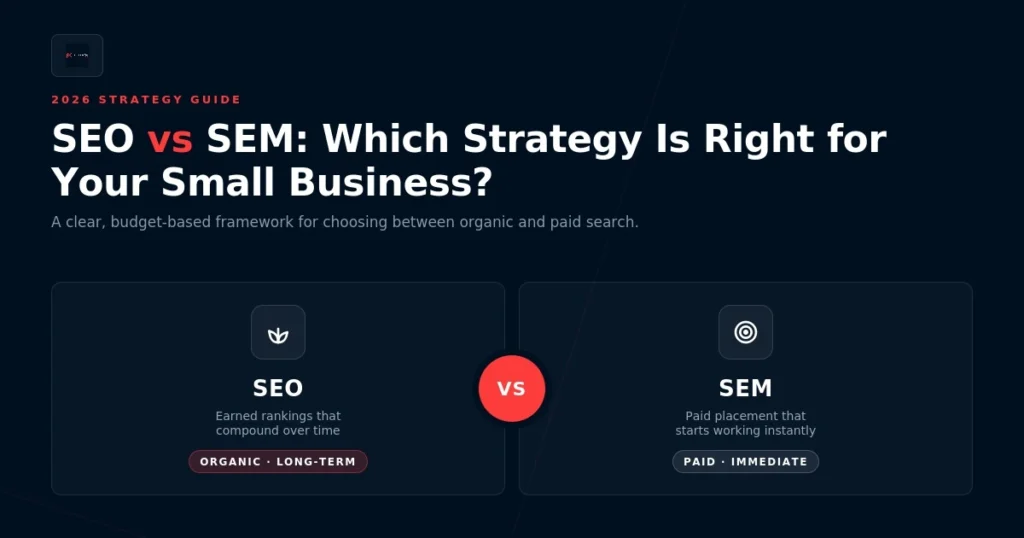
- SEO (Search Engine Optimization): Earns visibility through organic rankings. It takes 3–6 months to gain momentum, but compounds over time without per-click fees.
- SEM (Search Engine Marketing): Buys immediate placement atop search results via Google Ads. It generates traffic instantly, but stops running the moment your budget runs out.
What Is SEO?
SEO is the process of improving your website so it ranks higher in unpaid, organic search results. You’re not paying Google for the placement. You’re earning it by making your site genuinely easier to find and more relevant to what people are searching for.
SEO breaks down into four core parts:
- On-page SEO: Your content, page titles, headings, and how naturally your target keywords appear
- Technical SEO: Site speed, mobile-friendliness, and structured data that helps Google understand your pages (covered in more depth in our Website & Conversion Checklist)
- Off-page SEO: Backlinks, citations, and mentions from other sites that build trust and authority
- Local SEO: Your Google Business Profile and local search visibility, critical if customers find you by searching “near me”
The tradeoff: SEO usually takes three to six months to show real movement. But once you’re ranking, you’re not paying per click to stay there.
What Is SEM?
SEM stands for Search Engine Marketing. It means paying for visibility on search engine results pages instead of earning it organically. The most common form is Google Ads, where you bid on keywords and pay each time someone clicks your ad.
One thing worth clearing up before we go further: the industry isn’t consistent about what “SEM” actually includes. Some marketers use it to mean paid search only. Others use it as an umbrella term covering both SEO and paid search together. In this guide, we’re using the more common modern definition: SEM as paid search, since that’s how most small business owners hear it used today.
How SEM Works
- You choose keywords relevant to your business and set a bid for each one
- When someone searches that keyword, your ad enters an auction against other advertisers
- You pay only when someone clicks your ad, not just for it being shown
- Your ad stops appearing the moment your budget runs out or the campaign ends
What SEM Costs
| Factor | What It Means |
| Cost-per-click (CPC) | What you pay each time someone clicks your ad. This varies heavily by industry and competition |
| Daily/monthly budget | You set the cap, and Google won’t spend beyond it |
| Quality Score | Google’s rating of your ad relevance. A higher score can lower your CPC |
| Ad spend vs. results | Traffic and leads stop almost immediately once spend stops |
SEO vs SEM: The Key Differences
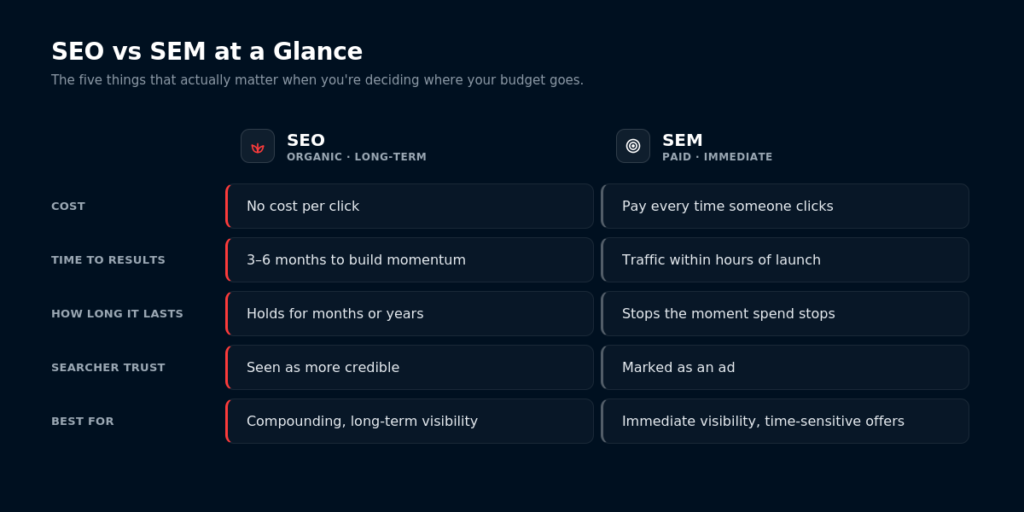
Once you understand what each one does, the real question is how they compare on the things that actually matter to a small business: cost, speed, and how long the results last.
| Factor | SEO | SEM |
| Cost structure | No cost per click. Investment goes into content, site work, or an SEO provider | Pay-per-click. You’re charged every time someone clicks |
| Time to results | Typically 3–6 months to see meaningful movement | Can generate traffic within hours of launching |
| How long results last | Rankings can hold for months or years with maintenance | Traffic stops the moment you stop paying |
| Budget control | Harder to predict exact ROI upfront | Easy to cap spend and measure cost per lead directly |
| Trust with searchers | Organic results are generally seen as more credible | Clearly marked as an ad, so some searchers skip them |
| Best for | Long-term, compounding visibility | Immediate visibility, testing offers, time-sensitive promotions |
Want a clear picture of where your budget would go furthest? [Get a free digital marketing assessment →]
Which One Should Your Small Business Choose?
This is where most guides shrug and say “it depends.” That’s technically true, but not useful. Here’s a real framework instead, based on the three things that actually decide it for a small business: your timeline, your budget, and how much competition you’re up against.
Choose SEO If…
- You’re building toward the next 1–3 years, not next month
- Your monthly ad budget is limited or close to zero
- Your industry has expensive cost-per-click rates (legal, insurance, home services often do)
- You want visibility that keeps working without ongoing spend once it’s built
Choose SEM If…
- You need leads or sales within days or weeks, not months
- You’re launching a new business or offer with zero current search visibility
- You’re running a time-limited promotion or seasonal campaign
- You have consistent monthly budget you’re comfortable spending on ads
A Simple Way to Decide
| Your Situation | Better Starting Point |
| Brand-new business, no online presence yet | SEM first, SEO running in parallel |
| Established business, steady budget, playing the long game | SEO-first, SEM for specific campaigns |
| Seasonal or time-sensitive offer | SEM |
| Very limited or no ad budget | SEO |
| High-competition, high-CPC industry | SEO-first, since SEM gets expensive fast |
What This Looks Like in Practice
Here’s a scenario that plays out often for small businesses weighing SEO against SEM.
Picture a local HVAC company with a decent website but almost no search visibility. They don’t show up organically for anything, and they’ve never run ads. They need leads now, but they also don’t want to be paying for every single customer a year from now.
A blended approach would typically look like this:
- Month 1–2: Launch SEM campaigns targeting high-intent, ready-to-buy searches like “AC repair near me,” while SEO work starts in the background: technical fixes, Google Business Profile optimization, core service pages
- Month 3–4: SEM keeps generating leads while the first SEO gains start showing up for lower-competition, longer-tail searches
- Month 5–6: As organic rankings climb for the highest-value keywords, ad spend can start shifting away from the terms SEO now covers, and toward gaps SEO hasn’t reached yet
The logic behind the order: SEM covers the gap while SEO is still building, and SEO gradually takes over the keywords that would otherwise mean paying for every click, indefinitely.
Can You Use Both?
Yes. Most businesses that succeed long-term end up doing exactly that. SEM covers the immediate need for visibility and leads. SEO builds the asset that eventually reduces how much you depend on ad spend. They’re not competing budgets. They’re solving different timelines.
The only real reason to pick just one is a hard budget constraint. If you can only fund one right now, use the framework from the section above to decide which one matches your actual timeline.
FAQ:
Q1: What’s the difference between SEO and SEM?
A. SEO earns traffic through unpaid, organic search rankings. SEM buys traffic through paid ads, usually Google Ads. SEO takes longer but keeps working after you stop investing. SEM works immediately but stops when you stop paying.
Q2: Should my small business use SEO or SEM?
A. It depends on your timeline. Choose SEM if you need leads within weeks. Choose SEO if you’re building visibility over the next year or more. Most businesses eventually use both.
Q3: Is SEO or SEM better on a small budget?
A. SEO, generally. It has no cost-per-click, so a limited budget goes toward building an asset rather than renting temporary visibility. SEM can still work on a small budget, but results stop as soon as spending does.
Final Thoughts
SEO and SEM aren’t rivals. They’re two different tools solving two different problems. SEM buys you visibility while you wait. SEO builds the visibility that eventually costs you nothing per click. Most small businesses that get real value from digital marketing end up using both, just not necessarily starting with both at once.
If you haven’t already, it’s worth working through our Digital Marketing Checklist for Small Business first. It covers where SEO and paid ads fit into your broader plan, not just against each other.
Not sure whether to start with SEO, SEM, or both? [Book a free 15-minute strategy call →]