You hired an SEO agency or started optimizing your own site and now you’re watching your Google Search Console dashboard like it owes you money. The impressions trickle in. The rankings barely budge. Your boss wants results. Your PPC bill keeps climbing. And the question burning in your mind is the same one 18,000 Americans search every month:
“How long does SEO actually take?”
Here’s the honest, data-backed answer: it depends but not randomly. In 2026, SEO doesn’t run on a single clock. It runs on three parallel tracks, each with its own timeline, each delivering a different kind of visibility. Once you understand this, the fog lifts entirely.
This guide covers verified industry timelines, real US business examples, and a framework that will help you stop guessing and start tracking the right milestones, whether you’re an HVAC company in Houston, a law firm in Chicago, a SaaS startup in Austin, or a restaurant trying to dominate your neighborhood’s Google Maps results.
The 3-Track SEO System: Why One Timeline Never Fits All
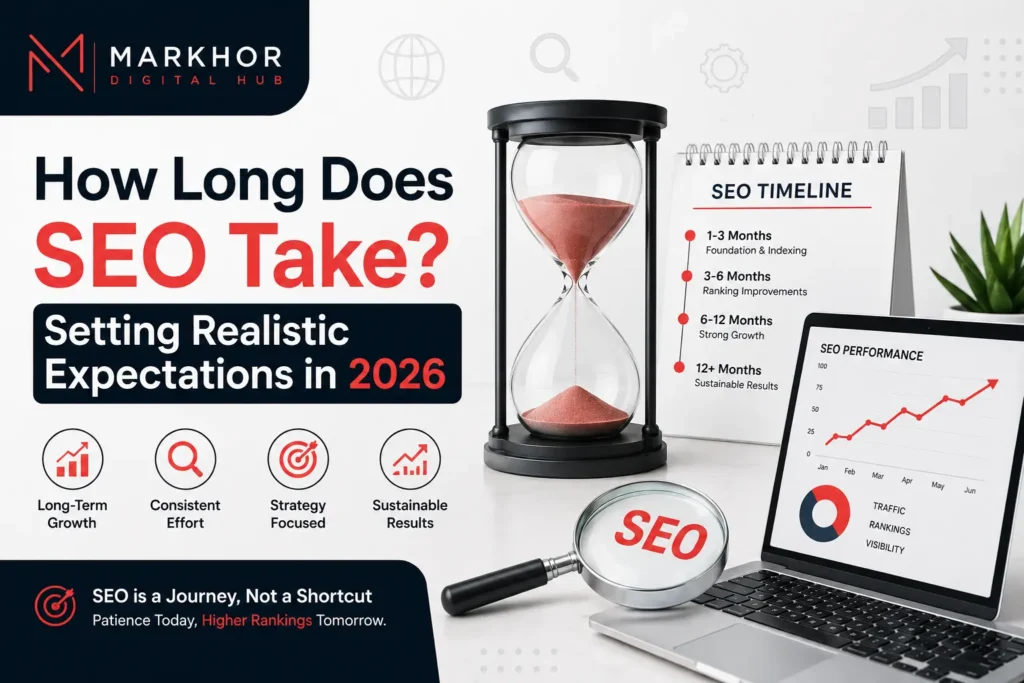
Most articles tell you “SEO takes 3–6 months” and call it a day. That’s not wrong — it’s just incomplete. In 2026, your website competes in three distinct search environments simultaneously, and each has its own pace:
| THE 3-TRACK SEO SYSTEM (2026) |
| 🔵 Track 1 — Google Blue-Link Rankings: 3–18 months depending on competition and domain age 📍 Track 2 — Local Map Pack / Google Business Profile: 4 weeks to 6 months 🤖 Track 3 — AI Overview & AI Tool Citations (AEO/GEO): 2–4 months for authoritative content |
This matters enormously for US businesses. A Dallas HVAC company waiting 12 months for blue-link rankings might get its first call in week 6 from a Google Maps optimization. A Chicago law firm might earn its first AI Overview citation in month 3, generating brand awareness and direct traffic months before a Page 1 ranking appears. Understanding all three tracks lets you set real expectations — and celebrate real wins — on the right timeline.
Track 1: Traditional Google Rankings (Blue Links) — 3 to 18 Months
This is what most people mean when they ask how long SEO takes. The answer varies dramatically based on four variables: your domain’s age and authority, your competition level, the quality of your content and technical setup, and the consistency of your effort.
The Standard Timeline Milestones
| Phase | Timeframe | What to Expect |
| Months 1–3 | Foundation Phase | Technical audit, Core Web Vitals fixes, content strategy mapped. Google crawls and indexes new/updated pages. Non-brand impressions rise in Search Console. No significant ranking movement yet for competitive terms. |
| Months 3–6 | Early Traction | Long-tail keywords begin appearing in Positions 8–20. Organic traffic shows first consistent upward curve. Internal linking improvements push relevant pages higher. First attributable leads may begin appearing. |
| Months 6–12 | Growth Phase | Primary keywords climb from Page 2–3 to Page 1. Featured snippet eligibility grows. Domain authority strengthens with backlink building. Organic becomes a reliable, growing lead channel. Most US SMBs see ROI in this window. |
| Months 12–18+ | Compounding Returns | Competitive head terms stabilize in Top 3. Content library earns passive backlinks. ROI compounds as cost per acquisition drops. Traffic from older content continues growing without additional spend. |
| 72.9% of pages ranking in Google’s Top 10 are more than 3 years old. The average #1 ranking page is approximately 5 years old. Source: Ahrefs, 2025 Ranking Study |
This single data point explains so much of the frustration new websites feel. You’re not competing against algorithms — you’re competing against pages that have been earning trust, clicks, and backlinks for years. That’s why timeline expectations differ so sharply based on where you’re starting from.
What Accelerates Track 1?
- Cuts ranking timeframes by ~40% compared to new sites.High-authority domain (DA 40+):
- Reaches organic traffic milestones 30% faster than lower-frequency publishers.Publishing 4+ quality blogs per month:
- Reduces time to rank by 20–25%.Strong internal linking structure:
- Can deliver ranking lifts in as little as 4 weeks.Technical fixes (site speed, Core Web Vitals):
- Lead to ranking boosts within 30–60 days in most industries.Content refreshes on existing pages:
- Generates traction 2x faster than going after high-volume head terms from day one.Targeting long-tail keywords first:

Track 2: Local Map Pack & Google Business Profile — 4 to 24 Weeks
If you’re a local US business — a plumber, dentist, restaurant, law firm, or HVAC company — Track 2 is where your fastest wins live. And in 2026, it’s more important than ever. According to BrightLocal, 46% of all Google searches have local intent. The Google Map Pack (the 3 businesses shown with a map above organic results) captures the majority of local intent clicks.
| A documented case study (November 2025 – March 2026) showed Google Business Profile optimization delivered an 86% increase in profile views and a 177% increase in customer interactions — without any changes to the website. Source: Local Contractor SEO Study, Vaza.ai 2026 |
Why Local SEO Moves Faster
The Map Pack algorithm weighs different signals than organic rankings. Proximity, relevance, and prominence (including reviews and GBP engagement) matter more than domain authority here. This means:
- A brand-new business can outrank a 10-year-old competitor in the Map Pack within weeks, if their GBP is optimized and reviews are flowing.
- Review frequency now outweighs total review count (Google’s 2025–2026 local algorithm update).
- Service area configuration is critical, overextending to cover an entire state weakens local relevance signals for your core market.
📍 Real US Business Example: HVAC Company in Phoenix, AZ
| Case Study — Phoenix HVAC Company |
| Starting Point: New GBP listing, no reviews, no website optimization. Competitor in Map Pack for ‘AC repair near me’ had 200+ reviews. Month 1: GBP fully optimized — correct primary category, 10 service listings, photos uploaded, service area defined. Month 2: 18 new verified Google reviews generated. Weekly GBP posts started. Core service pages updated on website. Month 6: Ranked in Map Pack for ‘AC repair Phoenix,’ ‘HVAC company near me,’ and 14 long-tail terms. Result: 3–4 inbound calls per week attributed to Google Maps. Cost: fraction of paid ads budget. Lesson: For local service businesses, GBP + reviews is the fastest ROI play in modern SEO. |
Track 3: AI Overview Citations & Generative Search (AEO/GEO) — 2 to 4 Months
This is the most important new timeline in SEO for 2026, and it’s the one most agencies aren’t telling you about.
Google AI Overviews now appear in up to 48% of all Google search queries (Ahrefs, March 2026). ChatGPT, Perplexity, and Google Gemini now drive real buying decisions — especially in B2B. Being cited in these AI responses is no longer a nice-to-have. It is a parallel visibility channel with its own rules and its own timeline.
| Being cited inside a Google AI Overview delivers 35% more organic clicks than not being cited on the same SERP. Brands cited in AI Overviews earn 91% more paid clicks. ChatGPT-referred visitors convert at 15.9% — vs. 1.76% for standard organic search. Source: Seer Interactive, Nov 2025 | Similarweb, June 2026 |
The AEO/GEO/AIO Timeline Is Shorter
Answer Engine Optimization (AEO), Generative Engine Optimization (GEO), and AI Input Optimization (AIO) share a common characteristic: AI systems reward clear, authoritative, well-structured content much faster than Google’s organic algorithm does. Firms doing the technical SEO work right can see AI Overview citations appear within 2–4 months of publishing strong, structured content — often before they crack Page 1 on traditional organic results.
What AI Systems Cite — And What They Ignore
- ✅ Clear definitional sentences in the first paragraph (direct answers to the query)
- ✅ FAQ sections with schema markup (FAQPage structured data)
- ✅ Named statistics with attributed sources (e.g., ‘According to Ahrefs 2025…’)
- ✅ Factual, specific, non-promotional tone throughout
- ✅ Article, BreadcrumbList, and Author schema implemented
- ✅ Content from domains with established topical authority in their niche
- ❌ Generic listicles, vague advice, keyword-stuffed paragraphs
- ❌ AI-sounding, repetitive, or padded copy
- ❌ Content that promotes before it informs
B2B SaaS Example: The AI Citation Advantage
| Case Study — B2B SaaS Startup, Austin TX |
| Challenge: 8-month-old domain. Competing against Hubspot, Salesforce for core terms. Traditional blue-link timeline: 12–18 months. Strategy: Published 6 highly structured thought-leadership articles with FAQ sections, schema markup, and named data sources. Month 3: Two articles earned AI Overview citations on mid-funnel queries. Zero Page 1 rankings yet. Month 3–6 result: 11% of all trial signups attributed to AI-referred traffic (ChatGPT + Perplexity). Conversion rate of AI visitors: 14.2% vs. 2.1% for paid ads. Key Insight: 92% of B2B software buyers say AI influenced their vendor shortlist in 2026 (Semrush). Earning AI citations during months 3–6 fills the gap while traditional rankings build. |
SEO Timeline by Industry — US Market Reference Guide (2026)
The table below reflects observed timelines across US markets. These are realistic ranges based on verified industry data, not marketing promises.
| Industry / Business Type | SEO Track 1 (Blue Links) | SEO Track 2 (Local/Maps) | SEO Track 3 (AI Citations) |
| Local Service (Plumber, HVAC, Electrician) | 6–12 months | 4–10 weeks ⚡ | 2–4 months |
| Law Firm (Personal Injury, Family Law) | 9–18 months | 6–14 weeks | 3–5 months |
| Restaurant / Food & Beverage | 3–6 months | 2–6 weeks ⚡ | 3–4 months |
| E-commerce (National) | 6–12 months | N/A (usually) | 4–6 months |
| Real Estate Agent / Broker | 6–12 months | 4–10 weeks | 3–5 months |
| B2B SaaS (Startup) | 12–18 months | N/A (usually) | 2–4 months ⚡ |
| Healthcare / Medical Practice | 9–18 months | 6–12 weeks | 3–6 months |
| Home Services (Cleaning, Landscaping) | 4–8 months | 3–8 weeks ⚡ | 3–4 months |
| Financial Services / Accounting | 12–24 months | 6–12 weeks | 4–7 months |
⚡ = Fastest opportunity for this business type. Prioritize accordingly.
Why Law Firms and Healthcare Take Longest
Google classifies legal and medical content as YMYL (Your Money or Your Life). These are held to the highest E-E-A-T (Experience, Expertise, Authoritativeness, Trustworthiness) standards. A personal injury law firm in Los Angeles isn’t just competing with other firms — it’s competing against Avvo, FindLaw, Martindale, and dozens of established legal directories that have been earning authority for 15+ years. Budget at least 9–12 months for meaningful results in major US metro legal markets.
The ROI Case: Why Waiting Is Worth It
The number one reason US businesses quit SEO too early is that they compare it to PPC on a 90-day timeline. That’s comparing a savings account to a lottery ticket. Here’s what the long-term data actually says:
| Median SEO ROI: 748% — or $7.48 returned for every $1 invested. Organic leads cost $31 each vs. $181 per lead through PPC. Organic search generates 44.6% of all digital revenue for B2B companies. Source: First Page Sage 2026 | HubSpot 2026 | BrightEdge 2025 |
The Compounding Curve
Unlike paid ads where performance flatlines the moment you stop spending, SEO follows a compounding growth curve:
- Month 6: ~0.8x ROI (early gains from technical SEO and quick content wins)
- Month 12: ~2.6x ROI (content and authority combine to drive consistent traffic)
- Month 24: ~4.6x ROI (rankings stabilize, content earns passive backlinks)
- Month 36+: ~5.2x ROI (SEO becomes a core growth asset, marginal cost approaches zero)
(Source: Incremys SEO ROI Model, March 2026, based on multi-client aggregated data)
Red Flags: When SEO Is Taking Longer Than It Should
Slow progress isn’t always normal. These warning signs suggest your SEO campaign may have structural problems that need fixing before timelines improve:
- Likely an indexing or technical issue — check Core Web Vitals, robots.txt, and crawl errors immediately.Zero impression growth in Search Console after 90 days:
- Classic vanity metric play. Insist on non-brand impressions and traffic data from Search Console.Agency shows you rankings for keywords nobody searches:
- Research precedes results. No plan = no timeline.No content map or keyword strategy delivered after Month 1:
- If they guaranteed positions rather than outcomes, you’re likely using black-hat tactics that will result in a Google penalty.Promised ‘Page 1 in 30 days’ guarantee:
- Legitimate SEO has receipts — crawl logs, content calendars, link acquisition reports, and GSC data.No visibility into what work was done:
- ‘How long will it take?’ is impossible to answer without analyzing who you’re trying to outrank.No discussion of your competition:
How to Accelerate Your SEO Timeline (Without Cutting Corners)
Quick Wins (Weeks 1–4)
- Fix all technical errors in Google Search Console (crawl errors, 404s, mobile usability issues)
- Fully optimize your Google Business Profile — photos, services, categories, and weekly posts
- Update your top 5 existing pages with fresh data, better headers, and internal links
- Add FAQ sections with FAQPage schema to your key service pages
- Ensure your NAP (Name, Address, Phone) is consistent across all directories
Medium-Term Actions (Months 1–6)
- Publish 2–4 well-researched articles per month targeting long-tail, high-intent keywords
- Build topical authority through content clusters — not individual random blog posts
- Start a consistent review-generation process for Google Business Profile
- Create a structured internal linking strategy connecting your pillar pages to supporting content
- Implement Article, FAQPage, and LocalBusiness schema markup sitewide
Long-Term Investment (Months 6–18)
- Build a digital PR strategy to earn backlinks from authoritative US publications
- Refresh older content every 6–12 months with updated data and expanded depth
- Optimize all content for AEO/GEO — clear definitions, cited sources, structured answers
- Develop E-E-A-T signals — author bios, case studies, client testimonials, and original research
- Monitor AI Overview citations using brand mention tracking tools
The Bottom Line
SEO in 2026 isn’t slow — it’s strategic. The businesses winning in organic search aren’t those with the most patience; they’re the ones who understand which of the three tracks they should prioritize first, build the right foundation, and track the right milestones.
If you’re a local service business in the US, your fastest path to leads is Google Business Profile (Track 2) — active within weeks. If you’re a B2B brand, AI citation optimization (Track 3) is where your earliest visibility wins live. If you’re building for long-term dominance, traditional blue-link rankings (Track 1) compound into the highest ROI digital marketing channel available — at $7.48 returned for every $1 invested.
You don’t have to choose one track. The strongest SEO strategies run all three in parallel from Day 1.
Ready to see your 3-Track SEO roadmap? Get a free Digital Growth Plan from Markhor Digital Hub.
Frequently Asked Questions (FAQPage Schema Ready)
Q: How long does SEO take to work in 2026?
A: For most US businesses, expect early movement in 3–6 months for traditional blue-link rankings, Map Pack visibility within 4–10 weeks (for local businesses), and AI Overview citations within 2–4 months of publishing authoritative content. Full, compounding results typically appear in the 6–12 month window. Highly competitive markets like personal injury law in major US cities can take 12–18 months for meaningful results.
Q: How long does local SEO take to show results?
A: Local SEO through Google Business Profile optimization is the fastest SEO track available. Most US local businesses see measurable improvements in Map Pack visibility within 4–8 weeks of fully optimizing their GBP, generating reviews, and ensuring NAP consistency. Competitive cities like New York, Los Angeles, or Chicago extend this to 10–16 weeks for the most competitive local niches.
Q: Why does SEO take so long?
A: SEO takes time because Google doesn’t reward sites immediately — it evaluates trust, relevance, and authority over time, comparing your pages against competitors that may have been earning those signals for years. Ahrefs’ 2025 research found that 72.9% of pages ranking in Google’s Top 10 are more than 3 years old. Building a competitive position means earning authority signals, content depth, and backlinks that take time to accumulate.
Q: How long does it take to see SEO results for a new website?
A: New websites face an additional challenge — they have zero established authority, no backlink profile, and no search history. Google processes and evaluates new sites cautiously. Realistically, new US websites should expect 4–6 months before any consistent non-brand traffic appears, and 9–12 months before meaningful organic leads materialize. Local businesses can accelerate this through Google Business Profile, which operates independently of domain age.
Q: What is GEO (Generative Engine Optimization) and how long does it take?
A: GEO (Generative Engine Optimization) is the practice of optimizing your content to appear as a cited source in AI-generated answers from tools like ChatGPT, Perplexity, Google AI Overviews, and Claude. Unlike traditional SEO, AI systems reward clearly structured, factual, well-attributed content — and they do so faster. Businesses publishing authoritative, FAQ-structured, schema-marked content typically begin earning AI citations within 2–4 months. This matters because ChatGPT-referred visitors convert at 15.9% — over 9x higher than the standard organic conversion rate of 1.76%.
Q: How long does SEO take for a law firm?
A: Law firm SEO takes 6–12 months minimum for meaningful results, with highly competitive markets (personal injury in Chicago, LA, or Miami) often requiring 12–18 months before significant lead volume from organic search. This is because legal content is classified as YMYL (Your Money or Your Life) by Google, which applies the strictest E-E-A-T standards. Law firms in smaller US markets or targeting niche practice areas typically see faster results — 4–6 months — because competition intensity is lower.
Q: Is SEO worth it compared to PPC (Google Ads)?
A: Yes — for long-term business growth. SEO delivers a median ROI of 748% compared to PPC’s long-term ROI of approximately 36%. Organic leads cost an average of $31 each vs. $181 through paid search. However, PPC delivers immediate visibility while SEO compounds over time. The optimal strategy for most US businesses is to run PPC for immediate lead flow while building SEO in parallel, then reduce PPC reliance as organic traffic grows. By month 12–18, many businesses find SEO alone generates enough volume to reduce paid ad dependency significantly.
Q: What kills SEO timelines? Why is my SEO not working?
A: The most common reasons US businesses don’t see SEO results on schedule include: (1) thin or generic content that doesn’t satisfy search intent, (2) technical issues blocking Google crawlers, (3) targeting keywords that are far too competitive for a new domain, (4) no consistent publishing schedule, (5) ignoring Google Business Profile for local businesses, (6) black-hat link building tactics that trigger Google penalties, and (7) stopping too early — most businesses that ‘quit SEO because it doesn’t work’ quit at month 3–4, right before the compounding growth phase would have begun.
Q: Can I rank on Google in 30 days?
A: For most meaningful keywords, no. However, long-tail keywords with very low competition can sometimes rank within 2–6 weeks of publishing high-quality content. Google Business Profile listings can appear in local search within days of creation and optimization. Technical quick wins (fixing crawl errors, improving page speed) can show ranking improvements within 4 weeks. Any agency promising guaranteed Page 1 rankings in 30 days for competitive terms is either targeting keywords nobody searches or using risky tactics that violate Google’s guidelines.
Q: How long does it take to rank #1 on Google?
A: The average top-ranking page has earned its position over approximately 5 years, according to Ahrefs’ 2025 data. However, this doesn’t mean you need 5 years to rank #1. High-authority domains targeting the right keywords with superior content can reach #1 positions in 6–12 months. For long-tail keywords in niche markets, #1 rankings are achievable within 2–4 months. The key is targeting achievable keywords for your current domain authority while building the authority needed to compete for bigger terms over time.