
Most small business owners handle marketing the same way: something breaks, a competitor outranks them, or sales slow down, and only then does anyone sit down to figure out what to do. That’s not a plan. That’s damage control.
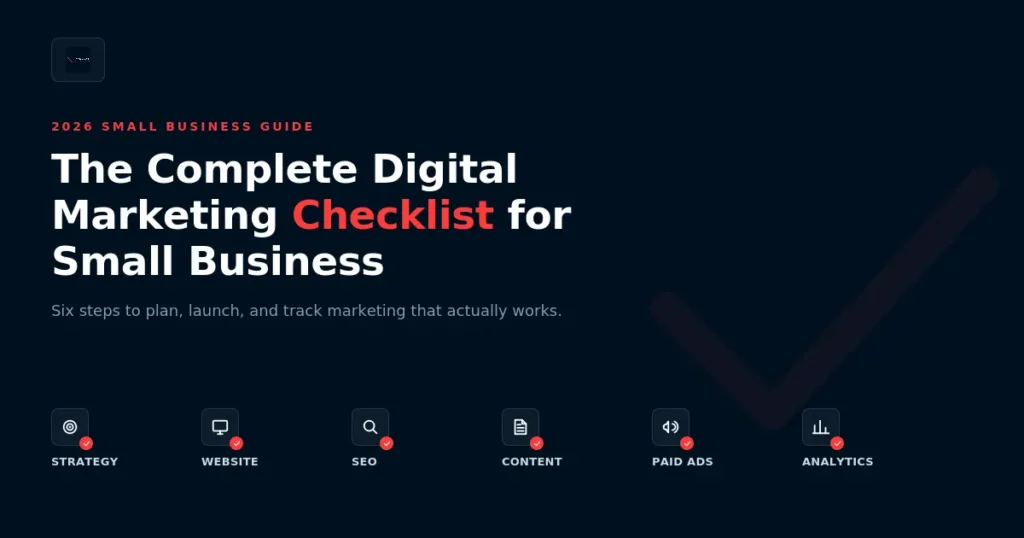
This digital marketing checklist for small business covers the six things every small business needs to get right, in the order you should actually do them: strategy, your website, SEO, content, paid ads, and tracking. It works best alongside a clear digital marketing strategy, not in place of one. If you’ve already worked out your budget, this is where that money gets spent.
Quick Answer: What’s in This Digital Marketing Checklist for Small Business
- Strategy and audit: Define your goals, your budget, and who you’re actually selling to
- Website and conversion: Make sure your site loads fast and turns visitors into leads
- SEO, local search, and AI search: Get found on Google, Google Maps, and tools like ChatGPT
- Content and social: Publish content that builds trust and shows up in social search
- Paid ads: Run campaigns that reach people who are ready to buy
- Automation and tracking: Know which leads are coming from where, and follow up automatically
Bookmark this online marketing checklist; you’ll want to come back to it every quarter.
Want this as a printable PDF? Download the full checklist and work through it offline. [Get the free PDF checklist →]
Not sure where your business currently stands? [Get a free 15-minute marketing audit →]
Strategy and Audit Checklist
Before you spend a dollar on ads or hire anyone, you need a plan. This is the part of your digital marketing strategy and planning that most businesses rush through, and it’s the part that matters most.
- Set one clear goal. Not “get more customers”; something specific, like 20 new leads a month.
- Know your numbers. Decide what percentage of revenue you’re putting toward marketing before picking a channel.
- Write down who you’re actually selling to: Age, location, income, and the one problem that makes them search for you.
- Check what your competitors are doing. Look at three competitors’ sites and social pages. Note what they’re missing that’s your opening.
- Pick two or three channels to start, not six. Running everything at once with no team burns budget with nothing to show for it.

Website and Conversion Checklist
A checklist without a website that actually works is pointless. You can nail your strategy, your ads, your content; none of it matters if someone lands on your site and leaves in five seconds.
- Test your load speed. Anything over three seconds and you’re losing visitors. Google’s PageSpeed Insights is free.
- Check it on a phone, not just your laptop. Most of your traffic is mobile.
- Put your call to action where people can’t miss it. “Call Now” or “Get a Quote” should be visible without scrolling.
- Make your contact form short. Three fields convert better than eight.
- Add real trust signals. Reviews, before-and-afters, client logos prove you’re a real business.
SEO, Local, and AI Search Checklist
This is where most small businesses either show up or disappear. If you’re not on the first page of Google, or not showing up when someone searches “near me,” you’re invisible to people actively looking for what you sell.
- Claim and complete your Google Business Profile. Hours, photos, categories, and services filled out in full.
- Get your basic on-page SEO right. Page titles, headings, and a meta description that actually describes the page.
- Build local citations. Your business name, address, and phone number should match exactly across Yelp, Facebook, and other directories.
- Add structured data to your site. This helps Google and AI tools understand exactly what you do and where you’re located.
- Write content that answers real questions. AI search tools pull answers from pages that directly answer a specific question.
Real Example: A local plumber in Dallas came to us with a decent Google Business Profile but a slow, unoptimized website; pages were loading in 5.2 seconds on mobile. We completed the GBP listing, added structured data, and brought load speed down to 1.9 seconds. Within three months, organic inquiries increased by 37%.
Content and Social Media Checklist
Content is what makes people trust you before they ever pick up the phone. It also tells Google, and now AI search tools, that you know what you’re talking about.
- Pick a publishing schedule you can actually keep. One good post a month beats four rushed ones you abandon by week three.
- Write about the questions your customers actually ask. Pull these from emails, calls, or reviews.
- Show your expertise, not just your services. Explaining how something works builds more trust than a page listing what you offer.
- Treat social media like a search engine. People now search Instagram and TikTok before Google; your captions need to answer real questions.
- Reuse your best content. One blog post can become a caption, an email, and a short video.
- Offer something in exchange for an email. A checklist, guide, or discount turns a visitor into a contact you can follow up with.
Paid Ads Checklist
Paid ads are the fastest way to reach people who are ready to buy right now. They’re also the fastest way to burn through a budget if you skip the basics.
- Target people who are ready to act, not just browsing. “Emergency plumber near me” is closer to buying than “how plumbing works.”
- Build a negative keyword list from day one. This stops ads showing up for irrelevant searches and saves money immediately.
- Send people to a page that matches the ad. A “free quote” ad should land on a page with a quote form front and center.
- Set a budget cap and check it weekly. Small daily checks catch problems before they get expensive.
- Know your target return before you spend a dollar. Decide what you’re willing to pay for one customer, and track it.

Automation and Analytics Checklist
Everything above this only works if you know what’s actually happening. Without tracking, you’re guessing which channel brought you a customer and which one wasted your money.
- Set up GA4 on your website. This tells you where visitors come from and what they do once they land. Skip this, and every other number here is a guess.
- Add conversion tracking to your ads and forms. Know exactly which click and which page led to a real lead.
- Get your leads into one place. A basic CRM, even a free one, beats leads scattered across email, texts, and sticky notes.
- Set up automatic follow-up. Most leads don’t buy on first contact; an automated sequence catches the ones who need a second nudge.
- Follow CAN-SPAM rules on every email you send. A real business address and a working unsubscribe link this is federal law, not optional.
- Review your numbers monthly. Ten minutes a month is enough to stop wasting money on what isn’t working.
Frequently Asked Questions
Q1: What should be in a small business marketing plan?
At minimum, a clear goal, a budget, a defined audience, and two or three channels to focus on that’s the core of any small business marketing checklist.
Q2: How often should I update my marketing checklist?
Every quarter. Your goals, your competitors, and Google’s own rules change often enough that a year-old plan is usually out of date.
Q3: Do I need a digital marketing agency, or can I do this myself?
You can handle parts of this yourself, especially strategy and social media. Most business owners run out of time or expertise with SEO, paid ads, and tracking; that’s usually where outside help pays for itself.
Q4: How much of this checklist should I do before hiring anyone?
At least the Strategy and Audit section. Walking into a hiring conversation with a clear goal and budget already set gets you better results and a fairer price.
Final Thoughts
None of this has to happen overnight. Pick one section, work through it, and move to the next. A business that’s slowly working through this checklist every month will outperform one that tries to do everything at once and burns out by March.
If you’ve already read our guide on [digital marketing costs for small business], you know what things should cost. This checklist tells you exactly what to spend it on.
Ready to put this into action but don’t have the time to do it alone? [Book a free 15-minute consultation with our team →]